
One of the most important—and least understood—decisions made during a California Department of Tax and Fee Administration sales tax audit is the selection of the audit test period.
Most business owners assume the auditor will review every sale made during the entire audit period. In reality, that is often impractical. A business may generate tens of thousands—or even millions—of transactions over a three-year audit period. Reviewing every invoice, register tape, receipt, purchase record, and exemption document could be prohibitively time-consuming for both the auditor and the taxpayer.
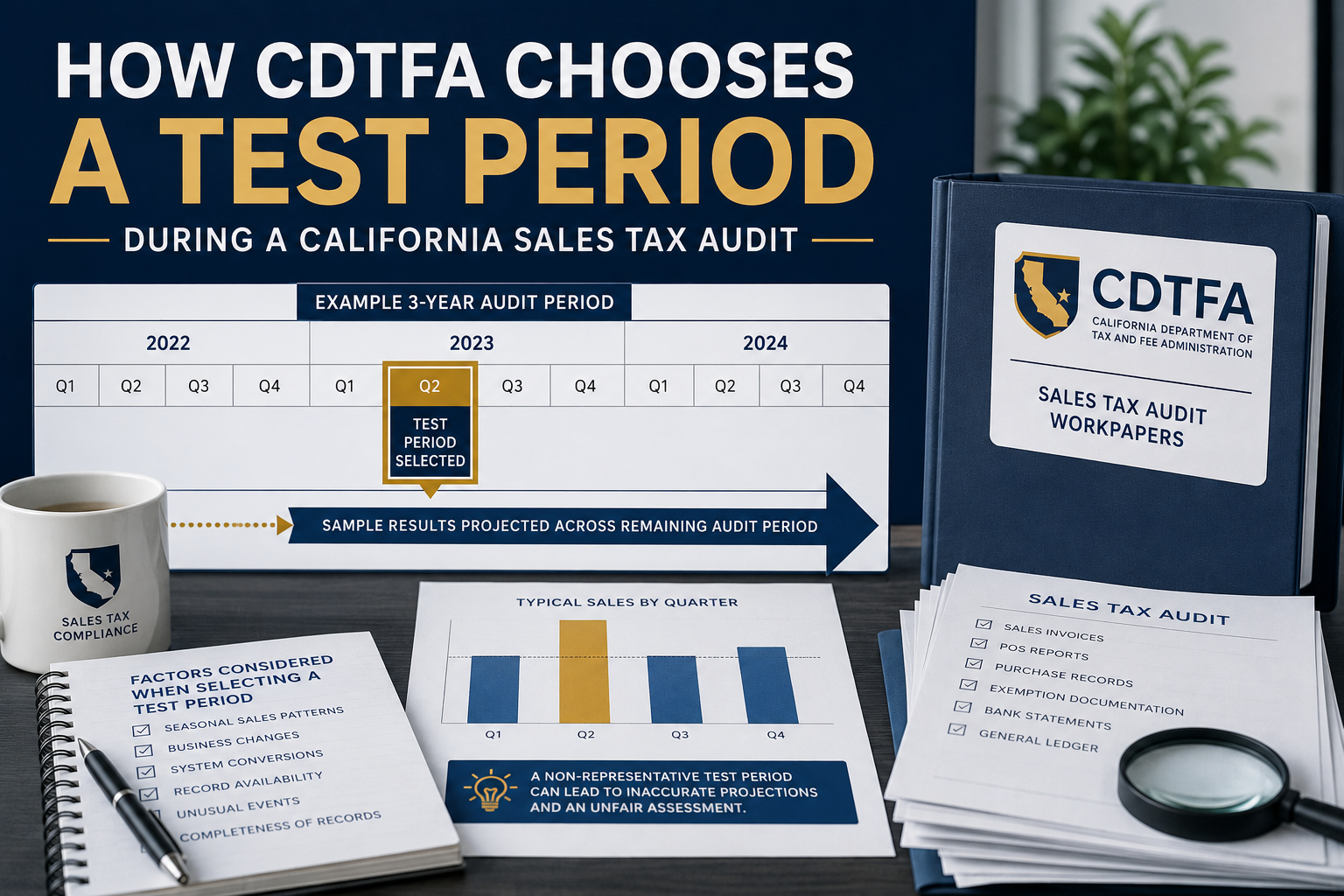
Instead, CDTFA auditors frequently examine a smaller portion of the audit period in detail. Findings from that sample may then be projected across the remainder of the audit period.
Although sampling can be an efficient and appropriate audit technique, the selection of the test period can materially affect the proposed assessment. A sample selected during an unusually busy season, an operational disruption, or a period in which accounting records were incomplete may not accurately reflect the business's normal activities.
Because the findings may be projected across several years, a seemingly modest decision about which month or quarter to examine can result in tens or hundreds of thousands of dollars in additional tax, interest, and potential penalties.
Understanding how CDTFA chooses a test period—and recognizing when the selected period may not fairly represent the business—is therefore an important part of CDTFA audit representation.
Business owners who are unfamiliar with the overall examination should also review our CDTFA sales tax audit process guide, which explains the stages of an audit from initial contact through the auditor's findings and any subsequent administrative challenge.
Why the Test Period Matters
Many taxpayers focus almost exclusively on the records requested by the auditor. Complete records are certainly important. However, the methodology used to evaluate those records may have a greater financial effect than any individual transaction.
Consider an audit covering three years. Instead of examining every transaction during all thirty-six months, the auditor may select one calendar quarter for detailed examination.
Assume the auditor concludes that taxable sales were understated by six percent during that quarter. Depending on the audit method and the available evidence, that error rate may then be applied to additional quarters within the audit period.
In practical terms, one quarter of activity may become the foundation for an assessment covering several years.
Audit Principle
The central issue is not whether sampling is used. The issue is whether the selected sample and projection methodology fairly reflect the taxpayer's business during the period under examination.
An inappropriate test period can distort the audit results when it includes unusual circumstances such as:
- Abnormally high seasonal sales
- Temporary business interruptions
- A conversion to a new point-of-sale system
- A grand opening or major reopening
- A liquidation or clearance event
- Inventory shortages
- Remodeling or construction
- Unusual staffing or management problems
- Temporary changes in purchasing patterns
- Economic disruptions affecting customer demand
The objective is not to avoid legitimate audit testing. It is to ensure that the testing fairly reflects the way the business ordinarily operated.
What Is a Test Period?
A test period is the specific portion of the audit period selected for detailed examination. Instead of reviewing every transaction over the entire audit period, the auditor examines a smaller segment of the taxpayer's records and uses the findings to evaluate compliance during other periods.
For example, assume CDTFA is auditing a retailer for January 1, 2022, through December 31, 2024. Rather than examining all thirty-six months of sales activity, the auditor may select April through June 2023 for detailed testing.
During the selected test period, the auditor may examine records such as:
- Sales invoices
- Point-of-sale reports
- Cash register tapes or transaction-level data
- Purchase invoices
- Resale certificates
- Exemption documentation
- Bank deposits
- General ledger activity
- Federal income tax returns
- Financial statements
Once the auditor identifies reporting differences or other audit adjustments within the sample, the findings may be used to estimate liability for additional portions of the audit period.
The critical question is whether the selected test period is representative. If it is not, the projected results may materially overstate or understate the taxpayer's actual liability.
Why CDTFA Uses Sampling
Even a relatively small retail business may process thousands of transactions each month. Larger businesses may process hundreds of thousands or millions of transactions every year.
Examining every transaction during a multi-year audit would frequently be impractical. Sampling allows the auditor to evaluate a manageable portion of the taxpayer's records and use an audit methodology intended to estimate the results for the remaining period.
Sampling may benefit both the agency and the taxpayer. It can reduce the time needed to complete an audit and limit the disruption associated with producing and reviewing several years of transaction-level information.
Those efficiencies depend on the test period and methodology producing a fair and reliable estimate.
The Importance of a Representative Sample
A test period is not selected merely to locate errors. Its purpose is to provide information that can reasonably be used to evaluate the taxpayer's activities during a broader period.
A representative sample ordinarily reflects normal business conditions, including:
- Typical sales volume
- Normal customer traffic
- Ordinary purchasing patterns
- Consistent pricing practices
- Regular staffing levels
- Stable accounting procedures
- Normal inventory availability
- Routine business operations
A period affected by unusual circumstances may produce misleading results when projected over several years.
Potentially distorting circumstances can include:
- Grand-opening promotions
- Going-out-of-business sales
- Major remodeling projects
- Temporary business closures
- Natural disasters
- Government operating restrictions
- Point-of-sale system conversions
- Significant changes in management or ownership
- Temporary inventory shortages
- One-time sales to unusually large customers
Each circumstance may affect sales volume, taxable sales percentages, purchase markups, cash ratios, inventory turnover, or another measurement used in the audit.
Sampling Is Intended to Be a Disciplined Audit Method
Some taxpayers assume that sampling permits an auditor to make a rough estimate or educated guess. A properly designed audit sample should instead use a disciplined methodology intended to approximate what a broader examination would have shown.
The reliability of the result may depend on:
- The quality and completeness of the taxpayer's records
- The size and duration of the selected sample
- The consistency of operations throughout the audit period
- The method used to project the findings
- Whether unusual transactions were identified and evaluated
- Whether the test period was truly representative
When those factors are carefully evaluated, sampling may provide a reasonable estimate of tax compliance. When they are not, the resulting assessment may warrant further examination or challenge.
Why Early Representation Matters
One of the most consequential mistakes a business owner can make is assuming that the audit methodology cannot be discussed until after the auditor issues proposed findings.
Important methodological decisions are often made early in the audit. Once an auditor has spent months performing detailed testing and projecting the findings, changing the methodology may become more difficult.
An experienced representative can evaluate the proposed test period before substantial testing is completed, identify unusual circumstances, assemble supporting documentation, and raise appropriate concerns while adjustments remain practical.
How Does CDTFA Actually Choose a Test Period?
There is no single test period that must be used in every CDTFA sales tax audit.
Depending on the business, the issues under examination, and the availability of records, the auditor may select:
- One calendar month
- One calendar quarter
- Several consecutive months
- Multiple sample periods
- Different periods for different audit issues
- A detailed examination of all available transactions
The auditor generally attempts to identify a period that reflects the taxpayer's ordinary course of business and that contains records sufficient to perform the required testing.
Factors That May Influence the Test Period
Seasonal Sales Patterns
Many businesses experience predictable fluctuations during the year. Examples include holiday retailers, restaurants in tourist areas, seasonal recreation businesses, pool supply stores, agricultural suppliers, and businesses located near seasonal attractions.
If sales or purchasing patterns vary substantially by season, a sample taken during one portion of the year may not accurately represent the remainder of the audit period.
Consistency of Business Operations
The auditor may evaluate whether the business operated consistently throughout the period under examination.
Relevant questions may include:
- Were the business hours stable?
- Were the same products or services offered?
- Did pricing practices remain consistent?
- Were there major staffing or management changes?
- Did the business relocate?
- Were additional locations opened or closed?
Significant changes may make a single sample less reliable as an indicator of the entire audit period.
Completeness of Records
The availability and reliability of the records may also influence the auditor's selection.
If detailed POS reports, invoices, bank statements, or other records are complete for one quarter but missing for another, the auditor may prefer the period with better documentation.
Record availability is important, but convenience alone does not necessarily establish that the period is representative.
Changes in Accounting or Point-of-Sale Systems
Businesses frequently change bookkeeping software, point-of-sale systems, merchant processors, inventory systems, or reporting procedures.
During a conversion, data may be migrated incorrectly, employee training may be incomplete, or sales classifications may temporarily become inconsistent.
A period that includes a major system conversion may therefore require careful evaluation before it is used as the basis for a multi-year projection.
Business Growth or Decline
A business may expand rapidly, lose major customers, add new product lines, discontinue existing operations, acquire another company, or close locations during the audit period.
If the nature or scale of the business changed materially, one quarter may not reasonably reflect all portions of the audit period.
Events That Can Distort a Test Period
Grand Openings and Reopenings
A new business or recently remodeled business may experience unusually high customer traffic, promotional discounts, abnormal advertising activity, or temporary pricing practices. Those conditions may not reflect stable, long-term operations.
Remodeling and Construction
A business undergoing renovation may have reduced capacity, shortened hours, temporary closures, altered customer access, or unusual purchasing patterns.
Natural Disasters and Emergencies
Wildfires, floods, earthquakes, storms, power interruptions, and local emergencies may significantly affect sales and purchasing activity.
Government Restrictions
Certain businesses experienced dramatic operational changes during periods of government restrictions. Restaurants shifted toward takeout and delivery, retailers expanded online sales, and capacity restrictions affected customer traffic.
Inventory and Supply Problems
Temporary shortages may reduce sales, change the mix of products sold, or force a business to substitute products carrying different markup percentages.
Those circumstances may distort an audit based on purchase markups, taxable sales ratios, or other indirect methods.
The Auditor's Objective Should Be a Fair Determination
Taxpayers sometimes approach an audit believing the auditor's only goal is to produce the largest assessment possible. That is not a productive way to evaluate the process.
The auditor is expected to determine the correct tax based on the available records and a reasonable methodology. An obviously unrepresentative sample can create problems for both the agency and the taxpayer.
An unreliable sample may:
- Increase the likelihood of disputes
- Require additional testing
- Prolong the audit
- Trigger supervisory or administrative review
- Produce a less defensible assessment
Discussions regarding the test period should therefore focus on accuracy, documentation, and the realities of the taxpayer's operations—not merely on whether a particular period produces a lower proposed liability.
A Practical Question to Ask
If you had to identify one quarter that best represents the ordinary operation of your business, which quarter would it be—and what records support that conclusion?
Can You Challenge CDTFA's Test Period?
A taxpayer may question a proposed test period when there is a legitimate, fact-based reason to believe the sample does not fairly represent normal business operations.
Merely preferring another month or quarter because it would produce a smaller assessment is generally not a persuasive basis for a change.
A meaningful challenge should explain:
- What unusual condition occurred
- When the condition began and ended
- How it affected sales, purchases, or tax reporting
- Why the condition did not exist during the remainder of the audit period
- Why another period or methodology would produce a more reliable result
The discussion should be supported by records and a clear explanation of the relationship between the unusual condition and the audit measurement.
Documentation That Can Support a Challenge
The strength of an objection to the test period often depends on the quality of the documentation.
Financial Records
- Monthly profit and loss statements
- Sales journals
- General ledger detail
- Trial balances
- Monthly or quarterly comparisons
Point-of-Sale Records
- Daily sales summaries
- Department or product-category reports
- Taxable and nontaxable sales reports
- Transaction counts
- Discount and void reports
Inventory and Purchasing Records
- Inventory adjustments
- Vendor purchase histories
- Product-shortage documentation
- Inventory valuation reports
- Changes in product mix
Operational Records
- Construction contracts
- Building permits
- Insurance claims
- Photographs of renovations or damage
- Payroll records
- Lease agreements
- Business licenses
External Evidence
- News reports
- Weather records
- Emergency declarations
- Utility interruption notices
- Government closure orders
- Vendor correspondence concerning supply disruptions
Objective, contemporaneous evidence is generally more persuasive than a statement made after the audit has begun.
Alternative Sampling Methods May Be Available
Questioning the original sample does not always mean selecting one different quarter. Depending on the facts, other approaches may be considered.
Selecting a Different Test Period
If another period contains more complete records and better reflects ordinary operations, it may provide a more reliable basis for testing.
Using Multiple Test Periods
A seasonal business may be more accurately evaluated through multiple test periods representing different portions of the year.
Separately Evaluating Extraordinary Transactions
A test period may contain one or more unusual transactions that would distort a projection if treated as recurring. Those transactions may warrant separate analysis.
Expanding the Sample
A larger sample may reduce the influence of unusual activity and produce a more reliable measurement. Although expanded testing requires additional work, it may be appropriate when the original sample is too narrow to support a fair projection.
Timing Matters
Concerns about the test period should ordinarily be identified as early as possible.
By the end of the audit, the auditor may already have:
- Completed months of detailed testing
- Calculated and projected error rates
- Prepared audit schedules
- Invested substantial time in the existing methodology
A methodology can still be questioned later, including during the administrative review process. However, addressing the issue before extensive testing is completed may provide a more practical opportunity to resolve the disagreement.
Audit Tip
Waiting until the audit is substantially complete to question the test period may limit the practical options available. Review the proposed methodology before detailed testing becomes firmly established.
Professional Representation Can Improve the Discussion
Disputes over sampling are rarely resolved through emotion or confrontation.
A productive discussion normally requires:
- Complete supporting documentation
- A logical analysis of the proposed sample
- An understanding of the taxpayer's operations
- A clear explanation of the unusual circumstances
- Knowledge of the audit issues being measured
Instead of arguing that the proposed assessment is simply too high, an experienced representative focuses on whether the methodology accurately measures the taxpayer's reporting.
Practical Example: A Restaurant Test Period
Facts
Assume a restaurant is under audit for a three-year period. The auditor selects the fourth quarter of 2023 as the proposed test period.
Further review reveals that:
- The restaurant completed a major remodel in September.
- A new point-of-sale system was installed in October.
- Employees received limited training on the new system.
- December sales increased because of holiday banquets.
- Inventory adjustments were recorded during the POS conversion.
Analysis
Any one of these events may not necessarily disqualify the quarter as a test period. Taken together, however, they raise a legitimate question about whether the quarter reflects the restaurant's ordinary operations during the rest of the audit period.
A representative might evaluate whether a different quarter, multiple test periods, expanded testing, or separate treatment of unusual transactions would produce a more reliable result.
The objective is not to eliminate legitimate tax liability. It is to ensure that the assessment is based on a sample that fairly reflects how the business operated.
Frequently Asked Questions
Does CDTFA always use a test period?
No. The methodology depends on the size and nature of the business, the issues being examined, the quality of the records, and the volume of transactions. Some audits involve sampling, while others may include a detailed examination of all available transactions.
How long is a typical CDTFA test period?
There is no universal length. A test period may include one month, one quarter, several consecutive months, multiple periods, or another timeframe that is considered appropriate for the audit issue.
Can I ask the auditor to choose a different quarter?
Yes. A taxpayer or representative may request another period when there is a legitimate, documented reason that the proposed sample does not fairly represent the business. The request should explain why another period or methodology would produce a more reliable result.
What makes a test period representative?
A representative period generally reflects normal sales volume, purchasing patterns, product mix, pricing, staffing, inventory availability, and accounting procedures. Unusual events may make a period less representative.
What happens if the test period contains errors?
Depending on the audit methodology, errors identified during the sample may be projected across additional portions of the audit period. Even relatively small differences may therefore have a significant effect on the proposed assessment.
Is sampling permitted in a California sales tax audit?
Sampling is an accepted audit technique when examining every transaction would be impractical. The reliability of the resulting assessment depends on whether the methodology and sample fairly reflect the taxpayer's business activities.
What if my business changed during the audit period?
Significant changes—such as new locations, new product lines, software conversions, ownership changes, closures, or major interruptions—should be identified early. Those changes may affect whether one sample period can reliably represent the entire audit period.
Can a CPA help before the test period is selected?
Yes. Early representation may allow the CPA to review the proposed methodology, identify unusual circumstances, organize supporting documentation, and raise concerns before extensive testing has been completed.
Final Thoughts
Selecting a test period is more than an administrative step. It may establish the foundation for a substantial portion of the CDTFA audit.
When the sample fairly represents the business, the resulting projection may provide a reasonable estimate of the taxpayer's reporting. When the sample is affected by unusual circumstances, the projected assessment may materially misstate the actual liability.
Business owners often concentrate on individual receipts or invoices. Those documents matter, but the audit methodology itself may have a greater effect on the outcome than any single record.
Evaluating the proposed test period should therefore be an early priority in a California sales tax audit.
Need Help With a CDTFA Sales Tax Audit?
If your California business is under audit, the proposed test period and projection methodology may significantly affect the outcome.
Boulanger CPA and Consulting, PC represents California businesses during CDTFA sales tax audits, audit conferences, petitions for redetermination, and administrative appeals.
Schedule a Confidential Consultation