
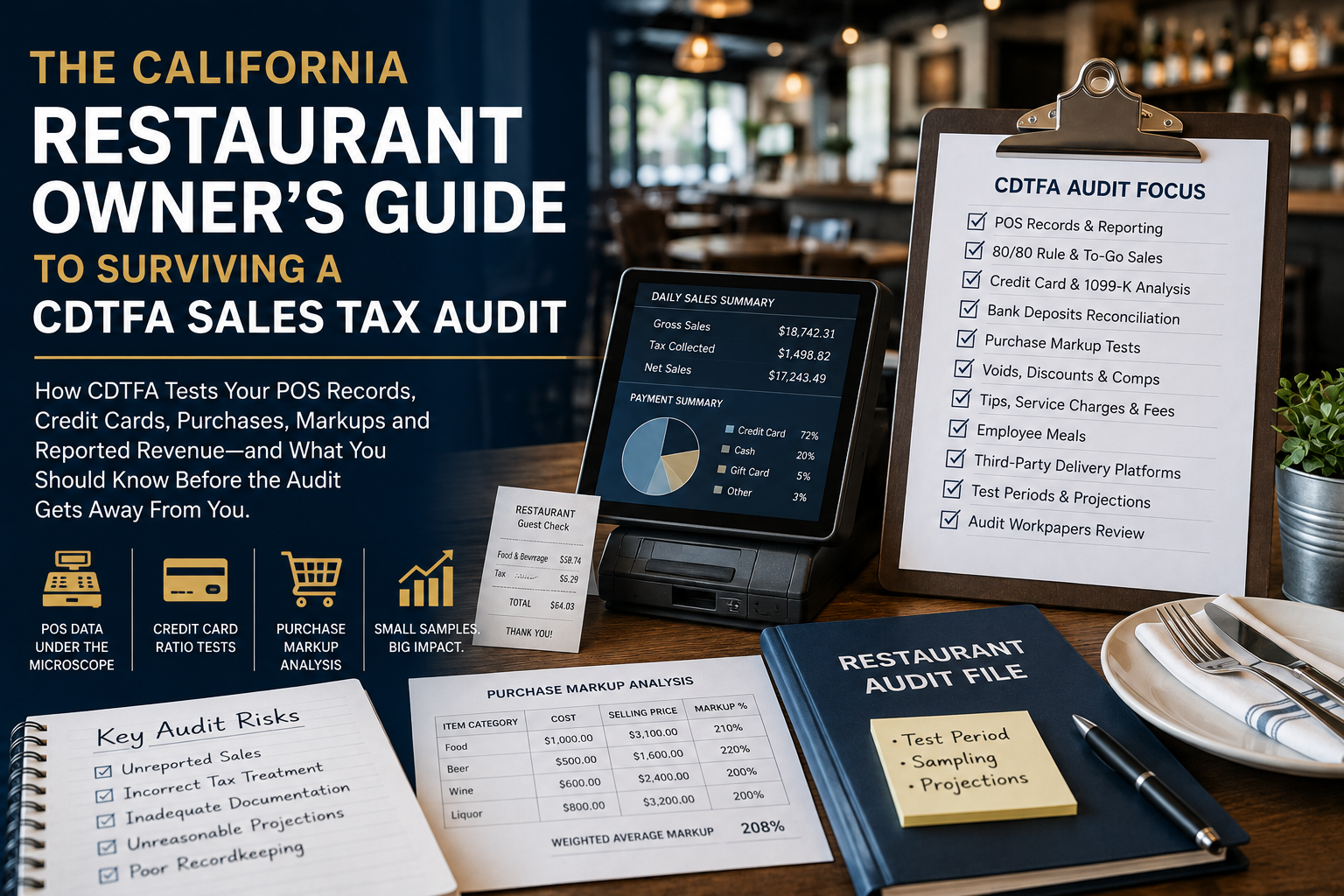
If your California restaurant has received a CDTFA sales tax audit notice, the audit may involve much more than reviewing the sales tax returns you filed.
The California Department of Tax and Fee Administration may examine your point-of-sale records, credit card activity, bank deposits, food and beverage purchases, cash sales, Form 1099-K information, federal income tax returns, financial statements, and other business records.
Depending on what the auditor finds, CDTFA may also use indirect audit techniques to determine whether your restaurant reported the correct amount of taxable sales.
Those techniques can include:
- Credit card ratio tests
- Purchase markup analyses
- Bank deposit analyses
- Observation tests
- Test periods and sampling
- Sales projections
- POS reconciliations
- Comparisons of purchases to reported sales
For restaurant owners, one of the most important things to understand is that an audit may eventually become less about the numbers originally reported and more about how the auditor reconstructs what they believe your sales should have been.
That distinction can have significant consequences.
A relatively small difference identified during a test period may potentially be projected across multiple quarters or years. What begins as a limited discrepancy can therefore develop into a substantial proposed sales tax assessment.
This guide explains how a CDTFA restaurant sales tax audit can work, the methods auditors may use, and the issues California restaurant owners should understand before accepting the auditor's conclusions.
Why Restaurants Can Be Particularly Difficult to Audit
Restaurants have characteristics that make them especially suitable for analytical testing.
A typical restaurant may process hundreds or thousands of transactions each week involving:
- Cash
- Credit and debit cards
- Dine-in sales
- Takeout orders
- Online orders
- Third-party delivery services
- Discounts
- Coupons
- Voids
- Refunds
- Complimentary meals
- Employee meals
- Gift cards
- Tips
- Service charges
- Catering
- Alcohol sales
At the same time, the restaurant purchases large quantities of food, beverages, alcohol, supplies, and other products.
This gives a CDTFA auditor multiple sources of information that can be compared against one another.
POS records → accounting records → sales tax returns
Credit card activity → estimated total sales
Food and beverage purchases → expected markup → estimated sales
Bank deposits → reported gross receipts
Observation results → expected cash and credit card activity
When these different sources reasonably support one another, the restaurant's records may present a coherent picture.
When they do not, the auditor may want to know why.
If the differences cannot be satisfactorily explained, CDTFA may consider using an indirect method to test or estimate sales.
1. Can CDTFA Rely on Your Restaurant's Books and Records?
One of the first important questions in a restaurant audit is whether the auditor believes the restaurant's books and records are sufficiently reliable.
Having QuickBooks, POS reports, bank statements, and filed tax returns does not necessarily end the inquiry.
The auditor may compare information from several sources, including:
- California sales and use tax returns
- Federal income tax returns
- Profit and loss statements
- General ledgers
- POS reports
- Merchant processor statements
- Form 1099-K information
- Bank deposits
- Purchase invoices
- Vendor statements
Consider a restaurant whose records show:
- Federal gross receipts:$2,400,000
- POS gross sales:$2,550,000
- General ledger sales:$2,420,000
- Sales reported to CDTFA:$2,310,000
Those differences do not automatically mean the restaurant understated taxable sales.
There may be legitimate explanations.
One figure may include sales tax while another does not. POS totals may include tips. Third-party delivery activity may be accounted for differently. Timing differences, refunds, gift cards, and other accounting classifications can also create differences.
The important question is whether those differences can be identified, reconciled, and explained.
If they cannot, the auditor may begin questioning the reliability of the reported sales.
That can change the direction of the audit.
2. What Records Does CDTFA Request in a Restaurant Audit?
Every CDTFA audit is different, but restaurant owners should be prepared for potentially extensive document requests.
The auditor may request:
- Sales and use tax returns
- Federal income tax returns
- Profit and loss statements
- Balance sheets
- General ledgers
- Bank statements
- Merchant processor statements
- Form 1099-K information
- POS sales reports
- Daily sales summaries
- Transaction-level POS data
- Sales journals
- Purchase invoices
- Vendor statements
- Inventory reports
- Historical menus
- Pricing information
- Resale certificates
- Exemption documentation
- Payroll information
- Documentation supporting nontaxable sales
A common mistake is assuming that the best response is simply to gather everything requested and send it to the auditor.
Before producing records, the restaurant should understand what those records actually show.
If three different reports contain three different sales figures, determine why.
If a POS report includes sales tax but the general ledger does not, understand the difference.
If merchant deposits include tips, identify them.
If a third-party delivery platform deposits an amount net of fees and commissions, understand the gross transaction before comparing the deposit to sales.
The restaurant should understand its own records before asking the auditor to interpret them.
3. POS Records Can Become the Center of a CDTFA Restaurant Audit
Modern restaurant point-of-sale systems can contain an enormous amount of information.
Depending on the system, reports may identify:
- Gross sales
- Net sales
- Taxable sales
- Sales tax collected
- Transaction counts
- Cash transactions
- Credit card transactions
- Discounts
- Voids
- Refunds
- Complimentary transactions
- Employee transactions
- Category sales
- Daily sales
- Hourly sales
- Online orders
- Delivery-platform orders
- Individual menu-item activity
This information can be extremely helpful when it is complete and consistent with the restaurant's other records.
It can also create additional audit questions.
An auditor might ask:
- Why do POS gross sales exceed the sales reported on the sales tax returns?
- Why are voids unusually high during certain periods?
- Why did the percentage of cash sales change significantly?
- Why are particular categories treated as nontaxable?
- Why do POS totals differ from the general ledger?
- Why do merchant processor records appear inconsistent with POS credit card sales?
Again, a discrepancy does not necessarily establish additional tax.
But unexplained discrepancies can cause an auditor to question the reliability of the books.
Before providing POS reports, restaurant owners should understand:
- Whether the report is tax-inclusive or tax-exclusive
- Whether tips are included
- How discounts are reflected
- How voids and refunds are reflected
- How gift cards are treated
- Whether third-party delivery sales are included
- Whether online and in-store transactions are combined
- How the report reconciles to the general ledger and tax returns
Producing raw POS data without understanding these issues can create unnecessary problems.
4. The California 80/80 Rule Can Become a Major Audit Issue
California restaurant owners should understand the 80/80 rule, particularly when the restaurant has treated certain food sales as nontaxable.
Generally, the rule becomes relevant when more than 80 percent of the business's gross receipts are from sales of food products and more than 80 percent of those food-product sales are otherwise taxable.
This can matter because certain cold food products sold to go may otherwise receive nontaxable treatment.
For a restaurant subject to the rule, properly identifying and documenting qualifying nontaxable transactions becomes particularly important.
During an audit, the question may therefore become more than:
Was this actually a qualifying to-go transaction?
The practical question may also be:
Can the restaurant prove how the transaction was treated from its records?
If a restaurant has historically reported substantial nontaxable food sales, it should understand how those transactions were identified within the POS system and what supporting documentation remains available.
A transaction that everyone at the restaurant remembers handling a particular way may be difficult to establish several years later without supporting records.
5. You Can Report Every Dollar of Revenue and Still Have a Sales Tax Problem
Restaurant audit exposure is not limited to unreported revenue.
A restaurant could record every dollar it receives and still have additional sales tax exposure if transactions were incorrectly classified.
That means there are really two different questions in many restaurant audits.
Did the restaurant report all of its sales?
This is primarily a completeness issue.
Did the restaurant correctly determine which transactions were taxable?
This is primarily a taxability issue.
Restaurant-specific taxability issues can involve matters such as:
- Food consumed on the premises
- Food sold to go
- The 80/80 rule
- Employee meals
- Tips
- Service charges
- Banquet transactions
- Online ordering
- Third-party transactions
- Other special food-service situations
A restaurant can therefore have excellent sales records while still facing an assessment because CDTFA disagrees with how particular transactions were treated.
6. How CDTFA Can Use Credit Card Ratio Testing
Credit card information gives an auditor an independent way to evaluate restaurant sales.
The concept behind a CDTFA credit card ratio test is relatively straightforward.
Suppose an auditor determines that approximately 80 percent of the restaurant's sales during a representative period were paid by credit card.
Assume annual credit card sales were $800,000.
$800,000 ÷ 80% = $1,000,000 estimated total sales
If the restaurant reported $900,000, the calculation produces a potential $100,000 difference that requires further investigation.
The arithmetic is easy.
The assumptions are where things become more complicated.
A proper analysis may need to account for:
- Sales tax included in settlements
- Tips
- Refunds
- Chargebacks
- Merchant processor withholdings
- Timing differences
- Third-party delivery activity
- Other settlement adjustments
That means the important questions include:
- Was the test period representative?
- Was the credit card percentage calculated correctly?
- Were tips properly identified?
- Were deposits properly classified?
- Were refunds and chargebacks considered?
- Were third-party delivery transactions handled correctly?
- Was the percentage appropriately projected to other periods?
A spreadsheet can be mathematically perfect and still produce an inaccurate audit result if the assumptions going into it are wrong.
Related resource: The CDTFA Credit Card Ratio Method: What California Business Owners Need to Know
7. How Powerful Can a Credit Card Ratio Become?
CDTFA's own Audit Manual provides an instructive example involving a sit-down Mexican restaurant.
In that example, a prior audit used three full-day observation periods to develop a credit card ratio of approximately 75.64 percent.
During a later audit, when records were not provided, the prior credit card ratio was applied to Form 1099-K credit card deposits as part of estimating taxable sales.
The lesson for restaurant owners is important.
A test involving a limited number of days can potentially become part of a methodology used to estimate a much larger period.
That does not mean every such projection is correct.
It means the assumptions used to create the ratio deserve careful examination.
8. Observation Tests: When a CDTFA Auditor Watches the Restaurant Operate
An observation test involves an auditor physically observing business activity during a selected period.
Depending on the purpose of the test, the auditor may attempt to measure:
- Total transactions
- Cash transactions
- Credit card transactions
- Taxable transactions
- Customer traffic
- Average sales activity
- Other operational information
The results may then be compared with the restaurant's reported activity or used in developing an indirect audit method.
The selection of the observation period matters.
A Tuesday afternoon may not represent Saturday night.
Valentine's Day may not represent an ordinary February day.
A major sporting event can alter activity at a sports bar.
Weather can affect customer traffic.
A holiday weekend can be dramatically different from a normal weekend.
If the results of an observation are going to influence a broader audit projection, restaurant owners should understand whether the selected period reasonably reflects normal operations.
9. Purchase Markup Audits: Reconstructing Restaurant Sales From Purchases
One of the most important indirect audit methods for restaurants begins with purchases rather than sales.
Instead of asking:
How much did the restaurant report selling?
the analysis asks:
Given what the restaurant purchased, how much would we expect it to have sold?
This is the basic concept behind a purchase markup audit.
Suppose a restaurant purchases food ingredients for $400 and those ingredients ultimately generate $1,000 of menu sales.
The gross profit is $600.
The markup on cost is 150 percent.
That is not the same as the gross profit margin, which would be 60 percent.
The distinction matters because an incorrect relationship between purchases and selling price can distort reconstructed sales.
Related resource: CDTFA Markup Audits Explained: What You Need to Know
10. Why Restaurant Markup Calculations Can Be Misleading
Real restaurants do not convert every dollar of purchases into a normal full-price customer sale.
Actual restaurant operations involve:
- Food waste
- Spoilage
- Theft
- Employee meals
- Complimentary meals
- Promotions
- Discounts
- Overportioning
- Product substitutions
- Menu changes
- Vendor price increases
- Happy-hour pricing
- Inventory fluctuations
- Self-consumption
Suppose an audit calculates a theoretical markup of 250 percent from selected products.
That does not automatically mean every purchase during a three-year audit period produced a 250 percent markup.
The product mix may have changed.
Menu prices may have changed.
Vendor costs may have increased.
Portion sizes may have changed.
Promotions may have changed.
Certain purchases may not have generated taxable retail sales at all.
The appropriate question is therefore not simply:
Did CDTFA calculate the markup correctly?
It is:
Does the markup reasonably represent what actually happened in this restaurant during the periods to which it is being applied?
11. Restaurants With Bars Can Face Separate Alcohol Markup Testing
Restaurants with substantial alcohol sales can present additional audit issues.
CDTFA's Audit Manual includes specific procedures for evaluating bar markups and distinguishes among categories such as:
- Well drinks
- Call drinks
- Cocktails
- Wine and liqueurs
- Domestic beer
- Premium and microbrew beer
This makes sense because alcohol does not have a single universal markup.
A premium cocktail does not necessarily have the same relationship between cost and selling price as a domestic beer.
Wine by the glass differs from wine by the bottle.
Draft beer differs from bottled beer.
Pour size matters.
Factors affecting actual bar markups can include:
- Pour sizes
- Self-consumption
- Happy-hour pricing
- Entertainment pricing
- Complimentary drinks
- Product mix
A bar markup worksheet should therefore not be accepted simply because the spreadsheet arithmetic is correct.
The underlying assumptions about product mix, selling prices, purchase costs, pour sizes, and other factors should also make sense.
12. Food and Bar Sales Need to Be Properly Segregated
Restaurants with significant alcohol activity should also consider whether food and beverage sales are properly classified in their POS and accounting systems.
A restaurant might report the correct amount of total sales while improperly assigning some beverage sales to food or some food sales to the bar.
That can distort departmental markup calculations.
For example, one department may appear to have an unusually low markup while the other appears unusually high.
Before interpreting that as evidence of unreported sales, the underlying sales classifications should be reviewed.
This illustrates an important audit principle:
The total may be correct even when the categories underneath it are not.
13. Bank Deposit Analysis: A Deposit Is Not Automatically a Taxable Sale
Bank statements provide another independent source of information that CDTFA may compare with reported sales.
A restaurant bank account may contain:
- Credit card settlements
- Cash deposits
- Third-party delivery deposits
- Owner contributions
- Loans
- Transfers between accounts
- Insurance proceeds
- Refunds
- Proceeds from asset sales
- Other non-sales amounts
Therefore:
Total bank deposits do not automatically equal taxable sales.
Suppose a restaurant has $2.7 million of deposits but reports $2.5 million of sales.
The $200,000 difference deserves analysis.
But the correct answer is not automatically $200,000 of unreported sales.
Perhaps $100,000 represents owner funding.
Perhaps $50,000 represents transfers from another account.
Perhaps another amount represents loan proceeds.
Those items should be identified and supported.
Unexplained deposits can create significant audit exposure. Properly documented non-sales deposits can tell a very different story.
14. Cash Sales Can Receive Additional Scrutiny
Restaurants that accept significant amounts of cash may receive additional scrutiny because cash activity can be more difficult to independently verify than electronic payments.
Accepting cash does not mean the restaurant has done anything wrong.
It does mean reliable contemporaneous records become particularly important.
An auditor may compare reported cash sales against:
- POS records
- Credit card activity
- Transaction counts
- Bank deposits
- Purchase levels
- Observation tests
- Historical sales patterns
Whether an auditor's conclusion is reasonable depends on the facts.
A restaurant's location, customer demographics, business model, delivery mix, and changes in payment behavior can all matter.
15. Tips, Gratuities, and Service Charges
Restaurant owners should be careful about assuming every amount labeled a "tip" or "gratuity" receives identical sales tax treatment.
California distinguishes between voluntary gratuities and certain mandatory charges.
The structure of the payment can matter.
Restaurants increasingly use:
- Automatic gratuities
- Mandatory service charges
- Large-party charges
- Banquet service charges
- Employee wellness charges
- Other customer surcharges
The terminology printed on a receipt does not necessarily determine the tax treatment.
Restaurant owners should understand how these charges are structured and how they are being reported for California sales tax purposes.
16. Voids, Discounts, Comps, Employee Meals, Waste, and Spoilage
Restaurant operations produce adjustments that do not represent ordinary full-price customer sales.
Voids
Orders may be canceled because of duplicate entries, kitchen mistakes, customer changes, or employee errors.
Discounts
Restaurants may offer coupons, loyalty discounts, happy-hour pricing, employee discounts, or manager adjustments.
Complimentary Meals
Food may be provided without charge because of a service problem, promotion, or management decision.
Employee Meals
Restaurants frequently provide meals to employees under various arrangements.
Waste and Spoilage
Food may spoil, be dropped, be overprepared, become unusable, or otherwise never generate a customer sale.
These items become particularly important during a purchase markup audit.
If an audit methodology effectively assumes that everything purchased ultimately became a full-price retail sale, expected sales may be overstated.
Contemporaneous records supporting these adjustments can therefore become valuable audit evidence.
17. DoorDash, Uber Eats, and Other Third-Party Delivery Platforms
Third-party delivery platforms have made restaurant accounting significantly more complicated.
A delivery transaction may involve:
- Gross food sales
- Sales tax
- Delivery charges
- Service charges
- Promotions
- Platform commissions
- Refunds
- Adjustments
- Net settlement deposits
The amount deposited into the restaurant's bank account may therefore be materially different from the amount paid by the customer.
This becomes particularly important when reconciling:
POS sales → delivery-platform statements → bank deposits → accounting records
Restaurant owners should understand how their systems record these transactions and which party is responsible for collecting and remitting tax on the transactions under review.
A net bank deposit should not automatically be treated as the gross sales amount, and the same transaction should not inadvertently be counted twice when multiple data sources are being reconciled.
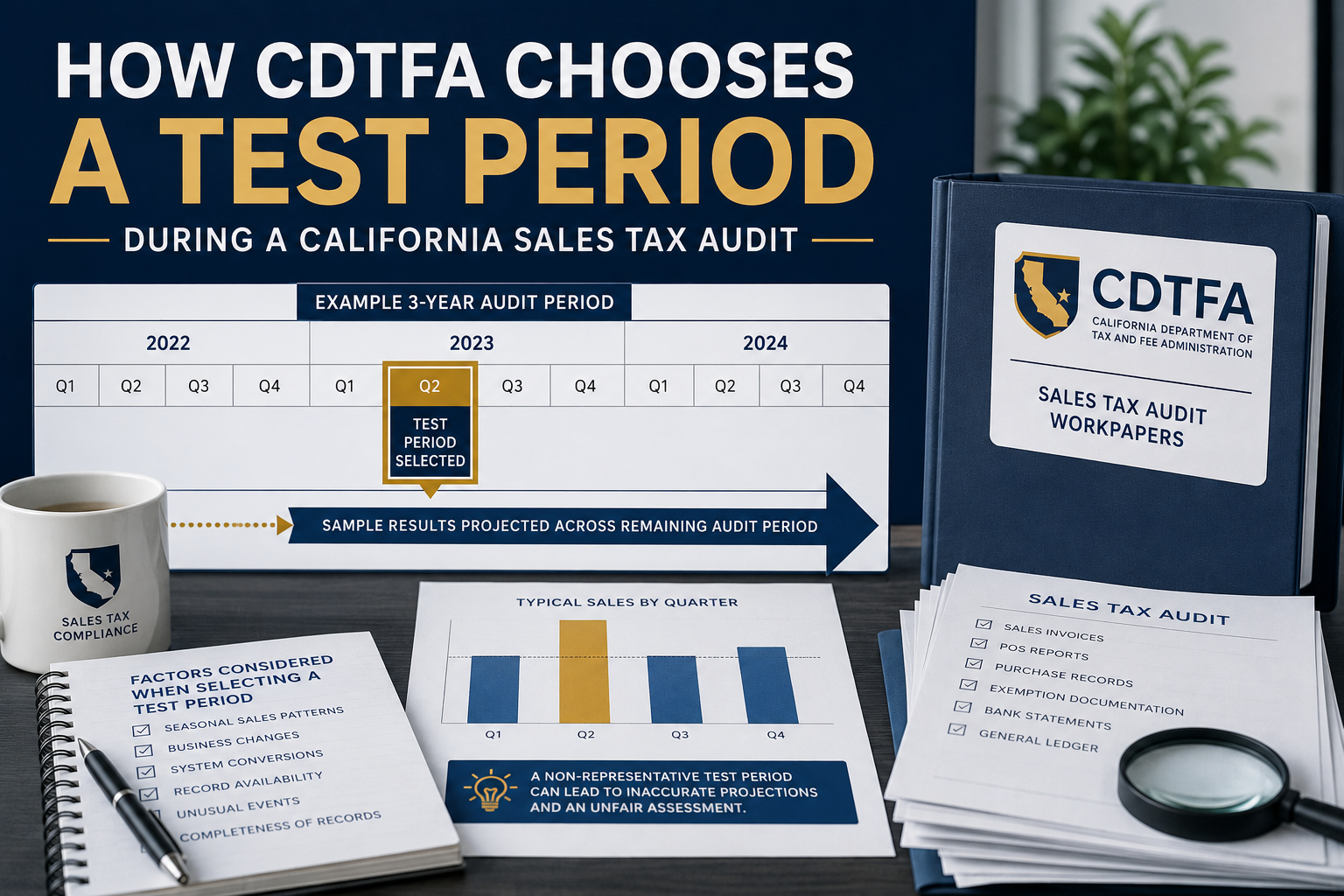
18. How CDTFA Chooses a Test Period
A CDTFA auditor may not examine every restaurant transaction occurring during the entire audit period.
Instead, the auditor may select a smaller period for detailed testing and use the findings from that period in evaluating a broader population.
This makes the selected test period extremely important.
Restaurant operations can vary because of:
- Seasonality
- Holiday traffic
- Grand openings
- Remodels
- Temporary closures
- POS conversions
- Menu changes
- Staffing changes
- Supply shortages
- Major promotions
- Changes in ownership
- Changes in delivery activity
- Changes in customer behavior
A period affected by unusual circumstances may not reasonably represent the restaurant's normal operations.
If CDTFA intends to use a test period to develop an error percentage or other projection, the restaurant should understand why that period was selected and whether it is representative.
Related resource: How CDTFA Chooses a Test Period During a California Sales Tax Audit
19. How a Small Test-Period Error Can Become a Large Assessment
Assume a restaurant reports $2,000,000 of taxable sales per year.
An audit test concludes that taxable sales were understated by 6 percent.
$2,000,000 × 6% = $120,000 of additional taxable sales per year
Across three years:
$120,000 × 3 = $360,000 of additional taxable sales
Tax is then calculated on the additional taxable measure.
Interest may apply.
Depending on the circumstances, penalties may also become an issue.
The financial significance is therefore no longer limited to the transactions examined during the original test.
The projection becomes the issue.
20. Sometimes the Projection Matters More Than the Original Error
Restaurant owners naturally focus on individual mistakes.
"That ticket was entered incorrectly."
"That deposit was a loan."
"That transaction was voided."
Those facts can certainly matter.
But sometimes the more important question is:
What did the auditor do with that error after finding it?
If a limited discrepancy becomes part of an error percentage that is projected over millions of dollars of transactions, the projection methodology may have a much larger financial effect than the original discrepancy.
A meaningful audit review should therefore examine both:
- Whether the underlying adjustment is correct
- Whether the method used to project it is reasonable
21. Do Not Assume CDTFA Audit Workpapers Are Infallible
CDTFA auditors prepare workpapers documenting their audit analysis.
These workpapers may contain calculations involving:
- Reported sales
- Purchases
- Markups
- Credit card ratios
- Bank deposits
- Test periods
- Error percentages
- Projections
- Proposed adjustments
A calculation can be mathematically accurate while being based on an incorrect assumption.
Questions worth asking may include:
- Was the correct population used?
- Were transactions duplicated?
- Were sales tax amounts treated consistently?
- Were tips properly identified?
- Were merchant processor amounts interpreted correctly?
- Were nontaxable transactions considered?
- Were purchases properly classified?
- Was the test period representative?
- Was the markup appropriate?
- Were unusual transactions considered?
- Was the resulting error percentage projected reasonably?
Related resource: What to Do If You Disagree With CDTFA Audit Findings
22. Common Mistakes Restaurant Owners Make During a CDTFA Audit
Producing Records Without Understanding Them
Do not assume more information is automatically better information.
Know what the records show and how they relate to one another.
Failing to Reconcile POS Records
If POS sales, financial statements, tax returns, and merchant records differ, understand why before those differences become an audit issue.
Explaining Important Issues Only Verbally
Important factual explanations are generally stronger when supported by documentation.
Ignoring the Test Period
A relatively short test period can potentially influence a multi-year assessment.
Focusing Only on the Proposed Tax
Understand how the auditor calculated the proposed adjustment.
Waiting Until the End to Question the Methodology
If there is a legitimate concern about the test period, population, markup, credit card ratio, or another methodological issue, it is generally better to identify it before the audit is effectively complete.
Assuming the Auditor Understands Your Restaurant
The auditor understands auditing.
You understand your restaurant.
Unusual operational circumstances may need to be explained and documented.
23. What Should You Do After Receiving a CDTFA Restaurant Audit Letter?
1. Determine the Audit Period
Identify exactly which reporting periods CDTFA intends to examine.
2. Preserve Your Records
Protect POS data, accounting records, bank statements, merchant reports, purchase records, and other potentially relevant information.
Do not assume your POS provider will retain historical information indefinitely.
3. Review the Filed Sales Tax Returns
Understand exactly what was reported.
4. Reconcile Major Sources of Sales Information
- POS sales
- General ledger sales
- Federal gross receipts
- Sales tax returns
- Merchant processor totals
5. Document Significant Changes in the Business
Create a timeline identifying events such as:
- Remodels
- Closures
- POS conversions
- Ownership changes
- Menu changes
- Supply disruptions
- Significant promotions
- New delivery platforms
- Major changes in operating hours
6. Review Nontaxable Sales
If the restaurant reported nontaxable sales, determine what records support the treatment.
7. Understand the Auditor's Requests
Know what is being requested and what each record contains before producing it.
8. Consider Professional Representation
Restaurant audits can become considerably more complicated once CDTFA begins developing an indirect audit method.
Professional representation may be particularly valuable when the audit involves sampling, markups, credit card projections, reconstructed sales, or substantial proposed adjustments.
24. Ten Questions to Answer Early in a Restaurant Sales Tax Audit
- Do the sales tax returns reconcile to the books?
- Do the books reasonably reconcile to federal income tax returns?
- Do POS totals reconcile to the general ledger?
- Do merchant processor totals reconcile to recorded credit card sales?
- Are tips properly identified?
- Are third-party delivery transactions accounted for correctly?
- Are reported cash sales reasonable compared with electronic payments?
- Are purchase records complete?
- Did the restaurant experience material operational changes during the audit period?
- Is CDTFA considering an indirect audit method?
25. Warning Signs That CDTFA May Be Developing an Indirect Audit Method
Potential signals include requests for:
- Detailed purchase invoices
- Vendor summaries
- Historical menus
- Merchant processor statements
- Form 1099-K information
- Transaction-level POS data
- Bank statements
- Cash-versus-credit information
- Observation visits
These requests do not necessarily indicate a problem.
But they may indicate that the auditor is attempting to independently test whether reported sales are reasonable.
26. What Happens If You Disagree With the CDTFA Audit?
Restaurant owners do not have to assume every proposed audit adjustment is correct simply because it appears on an auditor's workpaper.
During the audit, disagreements may be addressed through:
- Additional documentation
- Written explanations
- Reconciliations
- Alternative calculations
- Challenges to assumptions
- Discussions regarding the audit methodology
If disagreements remain unresolved and CDTFA eventually issues a Notice of Determination, formal protest and administrative procedures become important.
Related resource: How to Respond to a CDTFA Notice of Determination
27. The Goal of Restaurant Audit Defense
Effective CDTFA audit representation is not about hiding information or fighting every adjustment.
The objective is a fair and supportable determination of the correct tax.
If an assessment is increased because of:
- An unrepresentative test period
- Incorrect classification of deposits
- Improper credit card assumptions
- An unrealistic purchase markup
- Failure to account for waste or other adjustments
- Incorrect treatment of tips or service charges
- Misclassification between food and bar sales
- Duplicate transactions
- An inappropriate projection method
those issues deserve careful examination.
28. A Hypothetical Restaurant Audit Example
Consider a California restaurant reporting approximately $2.5 million of annual sales.
The auditor identifies differences between POS information and the sales tax returns.
Merchant processor records are then examined, and a credit card percentage is developed using a selected test period.
That percentage is applied to electronic payment information to estimate total sales for the three-year audit period.
The resulting calculation suggests reported sales were understated by approximately 7 percent.
Questions might include:
- Was the selected period representative?
- Did it include unusual holiday activity?
- Did the restaurant change POS systems?
- Were tips included in credit card amounts?
- Were third-party delivery transactions duplicated?
- Were refunds and chargebacks properly considered?
- Did the restaurant's percentage of cash sales change during the audit period?
- Were sales tax amounts treated consistently?
- Is one percentage reasonably representative of every quarter?
If an important assumption is incorrect, the resulting multi-year projection may also be incorrect.
Facing a CDTFA Audit of Your California Restaurant?
Restaurant sales tax audits can involve much more than reviewing filed returns.
CDTFA may analyze POS data, credit card transactions, bank deposits, purchases, cash sales, markups, test periods, sampling, and other records to independently evaluate reported taxable sales.
Boulanger CPA and Consulting PC represents California businesses in CDTFA sales and use tax audits and related administrative disputes.
If your restaurant has received a CDTFA audit notice, is already providing records to an auditor, or has received proposed audit adjustments, you can schedule a consultation to discuss your situation.
California Restaurant CDTFA Audit Checklist
Preserve and Gather Records
- POS records and historical data
- Filed sales tax returns
- Federal income tax returns
- Financial statements
- General ledger
- Bank statements
- Merchant processor statements
- Form 1099-K information
- Purchase invoices
- Vendor records
- Historical menus and pricing
- Third-party delivery statements
Reconcile the Numbers
- POS sales to accounting records
- Accounting records to sales tax returns
- Gross receipts to federal returns
- Merchant processor totals
- Tips
- Refunds and chargebacks
- Transfers and non-sales deposits
- Cash-versus-credit percentages
Review Taxability
- Dine-in sales
- Takeout sales
- 80/80 rule
- Employee meals
- Complimentary items
- Tips and service charges
- Online ordering
- Third-party delivery transactions
Review the Audit Methodology
- Is CDTFA using a sample?
- Is the test period representative?
- Is CDTFA performing a purchase markup?
- Is CDTFA developing a credit card ratio?
- Has an observation test been proposed or performed?
- Is CDTFA performing a bank deposit analysis?
- How will identified errors be projected?
- Have the material audit workpapers been reviewed?
Frequently Asked Questions About CDTFA Restaurant Audits
Why would CDTFA audit a restaurant?
A CDTFA restaurant audit can arise for various reasons and does not necessarily mean the agency has already determined that sales were underreported. Once an audit begins, however, the auditor may compare tax returns with POS records, income tax returns, merchant processing information, bank deposits, purchases, and other records.
Can CDTFA estimate my restaurant's sales?
Depending on the circumstances and adequacy of the available records, indirect audit techniques may be used to test or reconstruct sales. Restaurant audit methods can involve purchase markups, credit card ratios, bank deposits, observation tests, and sampling.
Can CDTFA use my credit card deposits to estimate cash sales?
Credit card activity may be used as part of an audit methodology. If the auditor develops a reliable relationship between electronic payments and total sales, that relationship may potentially be used in evaluating reported sales. The underlying test period and adjustments can therefore be extremely important.
What is a CDTFA restaurant markup audit?
A markup audit uses purchases and selling-price relationships to estimate expected sales. The methodology may require consideration of product mix, menu prices, purchase costs, waste, employee meals, complimentary items, discounts, inventory changes, and other factors affecting actual restaurant operations.
Does CDTFA look at restaurant POS records?
POS records can be an important source of audit evidence. They may provide information concerning gross sales, taxable sales, payment methods, voids, discounts, refunds, transaction counts, and other activity.
Why does the CDTFA test period matter?
An auditor may perform detailed testing on a limited period and use the results in evaluating a broader audit period. If the selected period is not representative of normal business operations, the resulting projection may not accurately measure activity during other periods.
What happens if I disagree with a CDTFA restaurant audit?
Audit adjustments can be questioned during the examination. If disagreements remain and CDTFA issues a Notice of Determination, additional administrative procedures and deadlines apply. The appropriate response depends on the stage of the case and the specific issues involved.
Should I hire a CPA for a CDTFA restaurant audit?
Not every audit requires professional representation. Representation may become particularly valuable when the audit involves substantial exposure, incomplete records, purchase markup methods, credit card projections, sampling, reconstructed sales, or disagreements concerning CDTFA's methodology.
Final Thoughts
A CDTFA restaurant audit is not simply an exercise in locating receipts and producing accounting records.
In some cases, the audit can become an examination of the economics of the restaurant itself.
The auditor may effectively ask:
- What did the restaurant report selling?
- What did it purchase?
- How much should those purchases have generated in sales?
- How much activity was paid electronically?
- How much appears to have been cash?
- Do the bank deposits support the books?
- Does the POS data support the tax returns?
- Were transactions classified correctly?
- Is the selected test period representative?
- Can the findings reasonably be projected across several years?
Restaurant owners should therefore understand not only what CDTFA says is wrong, but how the auditor reached that conclusion.
Good records matter.
Good reconciliations matter.
Understanding the audit methodology matters too.
That is where meaningful CDTFA restaurant audit defense begins.
This article provides general educational information concerning California sales and use tax audits. It is not legal, accounting, or tax advice for any particular taxpayer. Every CDTFA audit is fact-specific, and the appropriate response depends upon the taxpayer's records, business operations, audit methodology, and procedural circumstances.