
How to Survive a Restaurant Sales Tax Audit in California

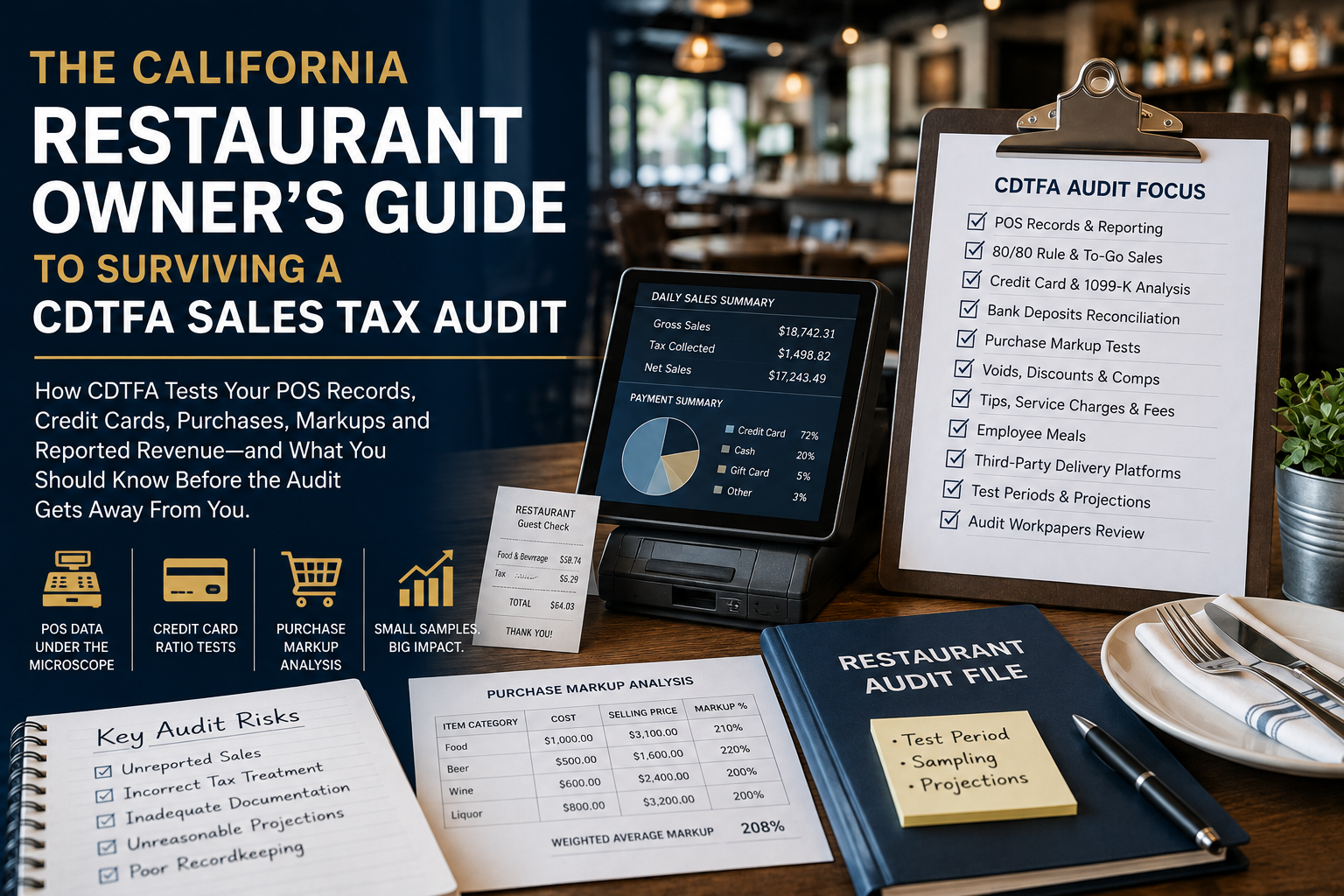
If you're a restaurant owner in California, you're a prime target for a CDTFA sales tax audit. Whether you run a fast-casual taco shop in Santa Ana, a sushi restaurant in Irvine, or a fine dining establishment in Newport Beach, the California Department of Tax and Fee Administration (CDTFA) is watching — and they audit restaurants more aggressively than almost any other industry.
In this guide, we’ll explain what triggers a CDTFA sales tax audit, what to expect during the process, and how to protect your business from costly mistakes.
To learn more about CDTFA audit defense for restaurants, visit our dedicated resource page.
WHY ARE RESTAURANTS TARGETED FOR CDTFA AUDITS?
Restaurants are cash-heavy, tip-driven, and often lack clean records — a perfect storm for sales tax enforcement.
COMMON AUDIT TRIGGERS INCLUDE:
- High percentage of cash sales
- Discrepancies between reported sales and POS reports
- Inconsistent tip handling
- Sales tax underpayment vs. industry benchmarks
- Missing or incomplete Z-tapes or daily summaries
- Prior late filings or CDTFA notices
Red flag: The CDTFA compares your restaurant’s reported sales against industry averages, vendor purchases, and 1099-K reports. If something doesn’t add up, they assume you’re underreporting.
The CDTFA also cross-checks your filings with vendors, 1099-K reports, and even IRS and FTB returns. That’s why it’s important to understand California FTB audit triggers—because state agencies often share information.
WHAT TO EXPECT IN A CDTFA RESTAURANT AUDIT
Restaurant audits are rarely simple. The CDTFA knows how to scrutinize hospitality businesses using industry-specific tactics. Here’s what’s likely to happen:
PRE-AUDIT QUESTIONNAIRE
You’ll be asked:
- How many employees do you have?
- What percentage of your sales are cash vs. card?
- How are tips handled?
- Do you use delivery platforms like DoorDash or Uber Eats?
Tip: These questions are designed to test your documentation. Be careful with your responses.
RECORDS REQUESTED
You’ll need to provide:
- POS reports
- Tax returns (federal and CA)
- Bank statements
- 1099-Ks
- Supplier invoices
- Tip logs and payroll data
- Delivery platform earnings
The CDTFA typically demands POS reports, tax returns, bank statements, 1099-Ks, invoices, tip logs, and payroll data. At this stage, you’re already responding to a CDTFA audit letter—and every document matters.
SAMPLING AND ESTIMATION
The CDTFA often uses:
Ingredient testing (e.g., alcohol purchased vs. alcohol sold)
CDTFA markup audits explained—where markup analysis and sample-month extrapolation are used to estimate sales.
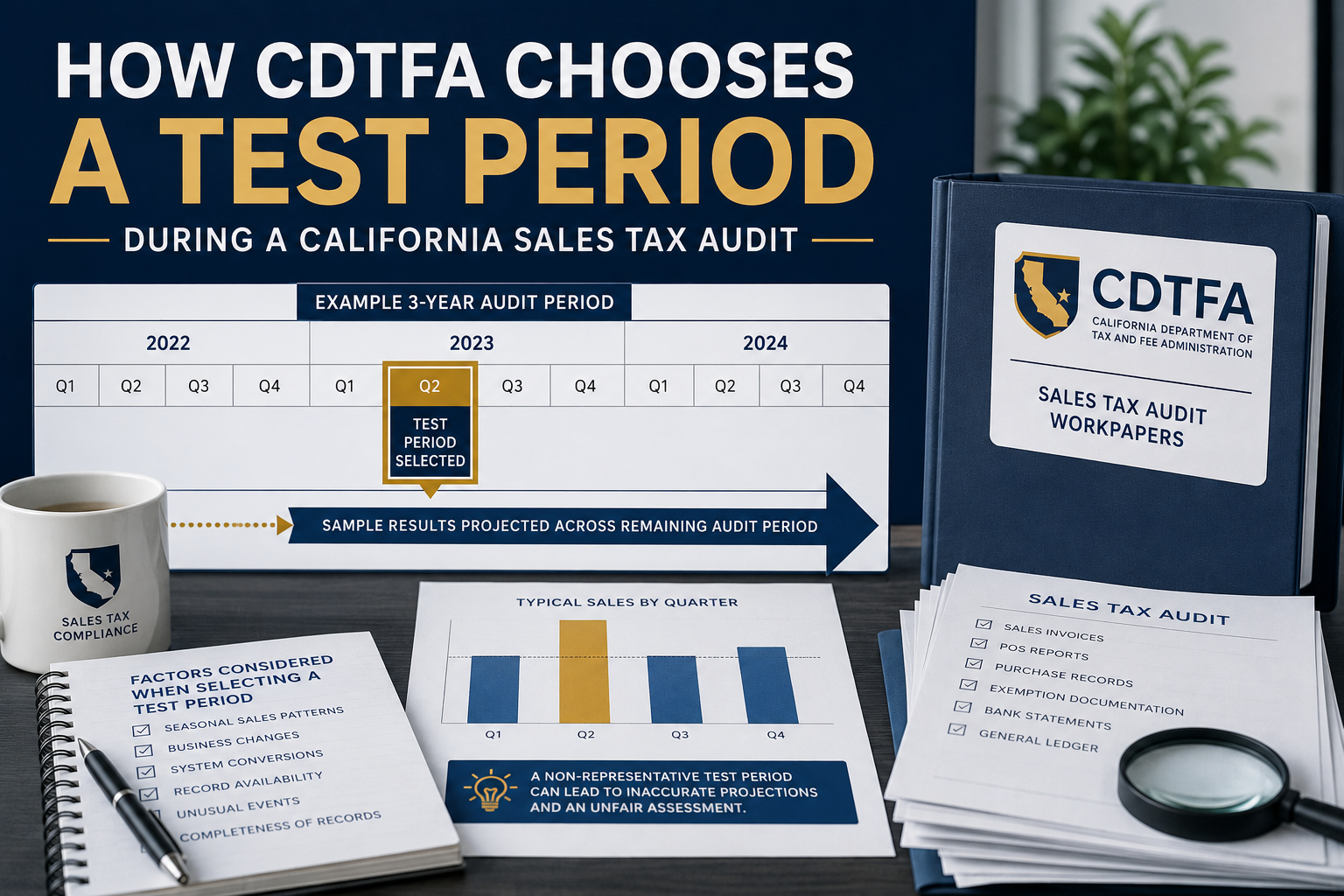
Sample month extrapolation
3rd-party data matching
Even if you’re using a POS system like Toast or Square, CDTFA may still estimate higher sales if:
Voids are excessive
Tips are inconsistent
Discounts or comps are undocumented
WHAT IF THE AUDITOR ESTIMATES TOO HIGH?
If you don’t push back:
You’ll be hit with inflated tax assessments
Penalties of 10–25%
Interest charges
Referral to the Franchise Tax Board (FTB) for income tax mismatches
This is where challenging CDTFA audit findings becomes crucial. By contesting flawed assumptions, you can significantly reduce your liability.
CASE STUDY: $124K ASSESSMENT REDUCED TO $17K
We represented a restaurant in Orange County facing a $124,000 CDTFA sales tax bill.
By reconciling POS data, validating cost-of-goods percentages, and challenging sample assumptions, we brought the final amount down to just $17,400.
This outcome shows the importance of strategy and persistence in negotiating a CDTFA audit balance.
WHAT HAPPENS IF YOU IGNORE THE AUDIT?
- The CDTFA will issue a Notice of Determination
- You’ll lose appeal rights if you don’t act in 30 days
- The CDTFA may place a lien on your business
- Bank levies, wage garnishments, and license suspensions are possible
- You may be referred for criminal investigation if suppression is suspected
HOW TO SURVIVE A CDTFA RESTAURANT AUDIT
✅ Do not speak to the auditor alone
✅ Review all POS records before submission
✅ Reconcile sales, comps, tips, and deposits
✅ Challenge any sampling methods or assumptions
✅ Get professional help immediately
WHY WORK WITH BOULANGER CPA
We help restaurant owners across California defend against CDTFA audits.
Our team has experience with:
- Fast-casual restaurants
- Full-service fine dining
- Alcohol-licensed establishments
- Multi-location franchises
We reduce assessments, stop liens, and fight for fair outcomes.
If you're dealing with CDTFA and Franchise Tax Board collections support, we handle both — together.
BOOK YOUR FREE STRATEGY CALL
We’re based in Orange County and serve restaurant clients throughout California. Let’s protect your business — and your peace of mind.
To protect your restaurant and your peace of mind, it’s time to learn more in Defend What’s Yours and take action now.
Frequently Asked Questions
Why are restaurants frequently audited by the CDTFA?
Restaurants are cash-heavy businesses with high audit risk. CDTFA auditors often use industry averages and markup tests to estimate unreported sales.
What records should restaurants keep for sales tax compliance?
Keep daily sales journals, POS reports, bank deposit slips, purchase invoices, and detailed meal tax breakdowns to defend against audit adjustments.
How far back can a restaurant audit go?
CDTFA typically audits three years of sales records but may expand further if underreporting or fraud is suspected.
What methods does CDTFA use in restaurant audits?
Auditors may use markup audits (cost of goods vs. sales), credit card-to-cash ratios, and industry benchmarks to estimate missing revenue.
What happens if CDTFA says I underpaid sales tax?
You may face large assessments, penalties, and interest. Professional help can challenge auditor assumptions and reduce liabilities.
Can CDTFA audits lead to IRS audits for restaurants?
Yes. CDTFA shares information with the IRS and FTB. A state sales tax audit can trigger parallel income tax audits.
How can a restaurant survive a CDTFA audit?
Keep detailed records, respond carefully to audit notices, and work with a CPA experienced in defending restaurant audits.

Marc Boulanger, CPA — California Sales Tax & CDTFA Audit Specialist
Marc is a CPA with many years of experience helping California business owners resolve complex sales tax and CDTFA audit matters. With formal training in accounting and a Master’s degree in Accounting, Marc combines technical precision with practical experience across industries such as restaurants, auto repair, retail, and multi-location franchises.
Outside of work, Marc enjoys traveling the country with his wife of 30 years and their five children. His approach to audit defense is built on clear communication, thorough analysis, and treating every client’s business as if it were his own.
Recent Posts