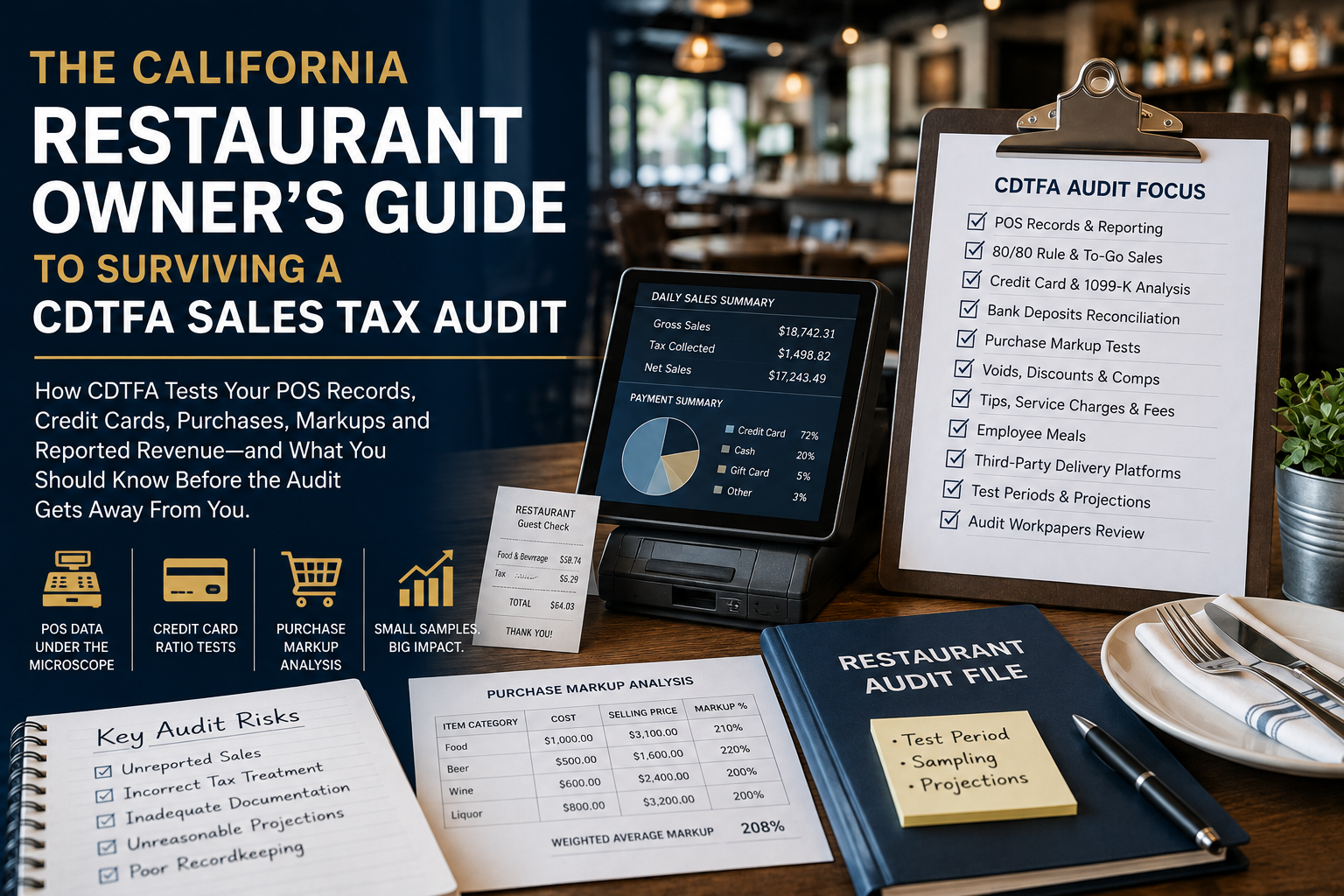

CDTFA Audit vs. IRS Audit – What’s the Difference?
If you're facing a sales tax audit from the California Department of Tax and Fee Administration (CDTFA), you may be wondering how it compares to an IRS audit. While both are government examinations of your records, the stakes, procedures, and strategies are completely different.
Here’s what you need to know about how CDTFA audits differ from IRS audits — and why it’s critical to handle them with a CDTFA-specific defense strategy.
🎥 Watch the Video Guide
Prefer a visual walkthrough? I recorded a quick video that explains exactly what to expect during a California CDTFA sales tax audit — from the first notice to appeals.
▶️ Watch the Video Now1. CDTFA AUDITS FOCUS ON SALES TAX
The biggest difference is the type of tax being audited:
- CDTFA enforces sales and use tax in California (not income tax)
- IRS enforces federal income tax and payroll-related issues
That means:
- CDTFA audits look at sales receipts, POS data, and taxable vs. non-taxable sales
- IRS audits review income, deductions, and reported federal income
If your issue is sales tax-related, an IRS representative may not be qualified to help you — and vice versa. Understanding what triggers a CDTFA sales tax audit can be the difference between a smooth resolution and a costly dispute.
2. CDTFA USES ESTIMATION METHODS
CDTFA auditors are more likely to use assumptions like:
- Industry markup percentages
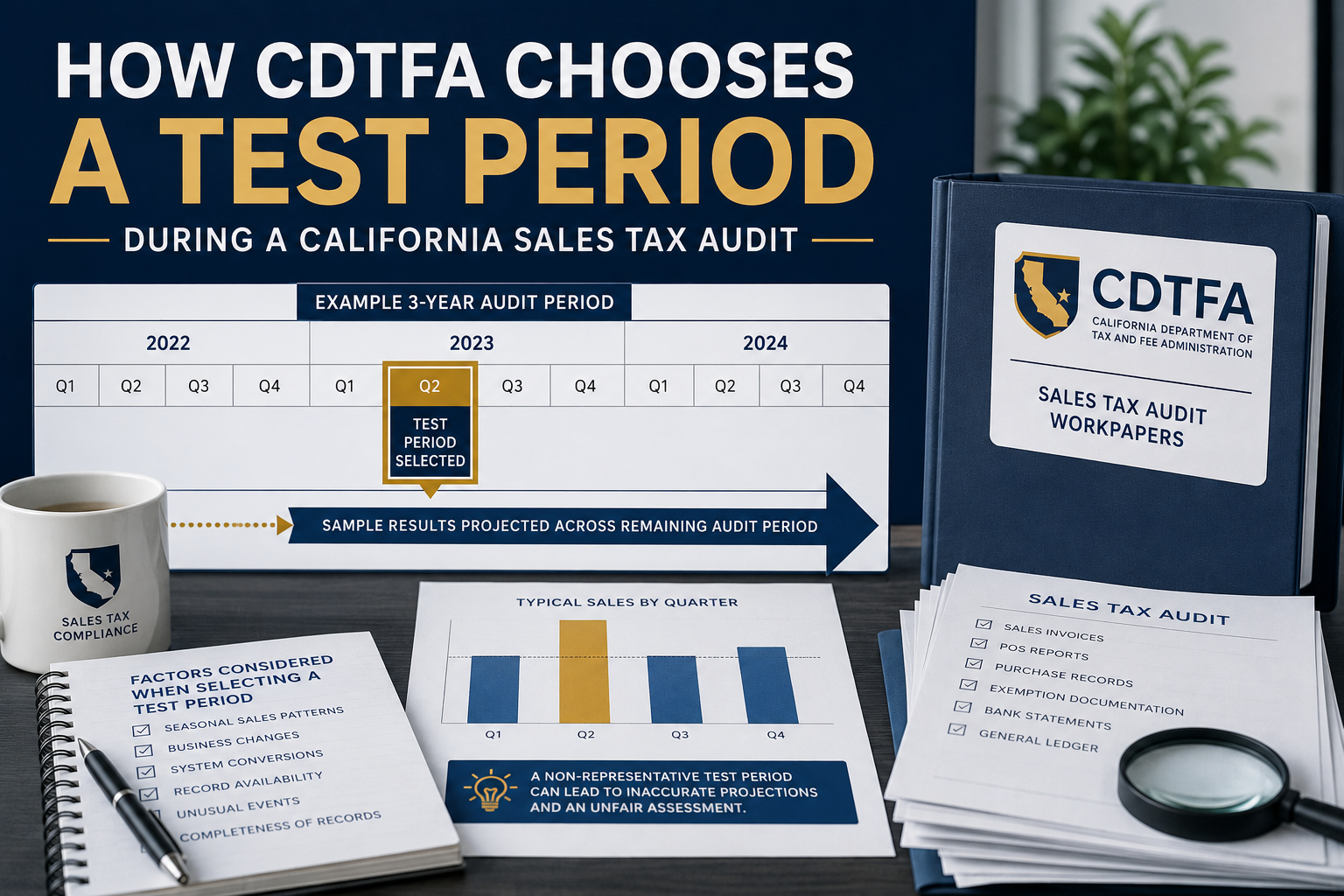
- Test periods or sample months
- Estimates based on purchases or inventory records
This means you could be hit with a large balance even if you kept reasonable books — especially if a few records are missing or out of sync.
IRS audits are typically more document-based and formulaic, while CDTFA audits lean heavily on inference and statistical modeling. Knowing how to handle responding to a CDTFA audit letter can prevent small issues from becoming major liabilities.
3. CDTFA AUDITS CAN ESCALATE FAST
CDTFA has the power to:
- Issue assessments quickly
- File liens and levies without going to court
- Suspend your seller’s permit
- Enforce personal liability if you’re the owner or officer
IRS collections can also be aggressive, but CDTFA’s process is often faster and more disruptive to daily operations. In some cases, success comes down to negotiating a CDTFA audit balance before collections actions hit your business.
4. THE RECORD REQUIREMENTS ARE DIFFERENT
CDTFA wants:
- Sales tax returns
- POS reports / Z-tapes
- Cash register summaries
- Bank records for deposits
- Resale certificates and exempt sales documentation
IRS wants:
- Federal returns (1040, 1120S, etc.)
- W-2s, 1099s, Schedule C
- Expense receipts and logs
If you mix up the two, you may not provide what the auditor actually needs — or you may give them too much.
Understanding the IRS audit assessment process and how it compares to CDTFA standards can help you prepare without exposing yourself to unnecessary risk.
BOTTOM LINE: YOU NEED A CDTFA-SPECIFIC STRATEGY
CDTFA audits are:
- Faster
- More assumption-based
- Focused on sales tax
- Harder to appeal if you wait too long
Even if you’ve handled an IRS audit before, a CDTFA audit is not a DIY situation. It requires a state-specific defense approach.
SCHEDULE A CALIFORNIA SALES TAX AUDIT STRATEGY CALL
At Boulanger CPA and Consulting PC, we represent California business owners in CDTFA audits every day — and we know how to reduce assessments and protect your business.
Frequently Asked Questions
What is the main difference between a CDTFA audit and an IRS audit?
A CDTFA audit focuses on sales and use tax compliance in California, while an IRS audit reviews federal income tax returns and reporting accuracy.
Which businesses are most likely to face a CDTFA audit?
Cash-heavy businesses like restaurants, convenience stores, and vape shops are frequent CDTFA targets, while the IRS audits both individuals and businesses of all types.
Can CDTFA and IRS audits happen at the same time?
Yes. CDTFA findings are often shared with the IRS and the California Franchise Tax Board (FTB). One audit can trigger another if discrepancies are found.
How far back can each agency audit?
The IRS typically audits up to three years but can extend to six for substantial errors or indefinitely for fraud. CDTFA usually audits three years but may extend further if fraud is suspected.
Do CDTFA audits use the same methods as IRS audits?
No. CDTFA often uses purchase records, markup tests, and industry ratios to estimate sales, while the IRS relies heavily on reported income, bank records, and information returns.
What penalties can result from a CDTFA audit?
Penalties include late payment, negligence, or fraud penalties, plus interest. The IRS also imposes accuracy-related and fraud penalties, but the taxes involved differ.
How should I prepare for each type of audit?
For CDTFA, keep detailed sales and purchase records. For IRS audits, maintain organized tax returns, income documentation, and expense substantiation. In both cases, professional help is strongly advised.
Which audit is more aggressive?
Both can be aggressive, but CDTFA is notorious for strict estimation methods in cash businesses, while the IRS enforces broader penalties across individuals and businesses.

Marc Boulanger, CPA — California Sales Tax & CDTFA Audit Specialist
Marc is a CPA with many years of experience helping California business owners resolve complex sales tax and CDTFA audit matters. With formal training in accounting and a Master’s degree in Accounting, Marc combines technical precision with practical experience across industries such as restaurants, auto repair, retail, and multi-location franchises.
Outside of work, Marc enjoys traveling the country with his wife of 30 years and their five children. His approach to audit defense is built on clear communication, thorough analysis, and treating every client’s business as if it were his own.
Recent Posts